
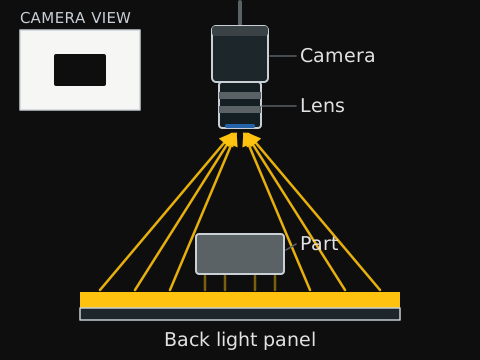
Back light
The light sits behind the product, facing the camera. The product shows as a sharp dark outline. Use it for counts, outlines, gaps, holes, and fill level in clear or translucent bottles.
Get started
×Tell us about the line. A person reads it and replies.
Or talk it through first:
30-minute Google Meet call, Monday to Friday, 9 am to 5 pm Pacific.
Need a full study of the line first?
Guides
How the angle, spread, and color of the light decide what a camera can see, and which lens keeps a measurement steady.
A camera records only the light that reaches it. A scratch, a dent, or an embossed code shows up when the light is placed so that the fault sends light toward the lens differently from the good surface around it. Station lights are strobed and shielded, so the picture stays the same whatever the room lights are doing.
The light sits behind the product, facing the camera. The product shows as a sharp dark outline. Use it for counts, outlines, gaps, holes, and fill level in clear or translucent bottles.
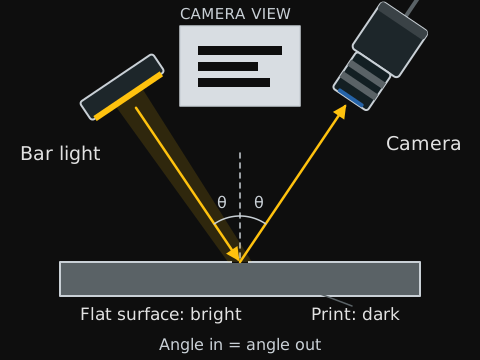
The light bounces off a flat surface straight into the lens. Smooth areas look bright, and print or a mark that breaks the surface looks dark. Use it for print on flat cartons and codes on labels.
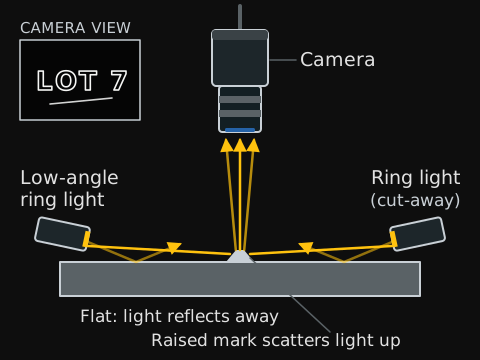
Low-angle light skims the surface. A flat surface reflects it away from the lens and looks dark, while scratches, chips, and raised or stamped characters catch it and glow. Use it for embossed lot codes and marks on glossy parts.
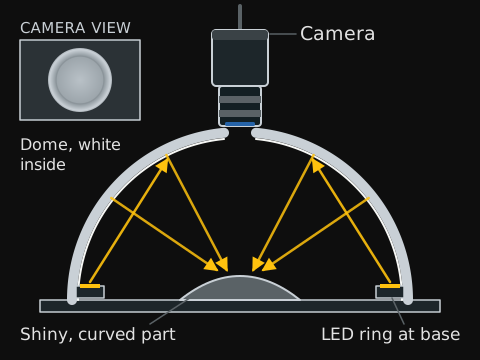
A dome or an on-axis light sends light from many directions at once, which removes glare and shadows. Use it on shiny or curved surfaces: foil lids, blister film, metal cans, and wrapped product.
Directed light, a narrow beam from one side, does the opposite of diffuse light. It casts shadows and makes texture stand out. Pick directed light when texture is the fault, and diffuse light when texture hides the fault.
Light that usually shows itBack light
Why it worksLiquid and headspace pass different amounts of light.
Light that usually shows itBack light, or diffuse light from above
Why it worksEach piece shows as its own outline.
Light that usually shows itLow-angle dark field
Why it worksRaised and cut edges catch light that skims the surface.
Light that usually shows itDark field
Why it worksThe flat surface stays dark and the mark lights up.
Light that usually shows itDiffuse dome or on-axis light
Why it worksGlare and hot spots disappear, so the print reads evenly.
Light that usually shows itWhite light with a color camera
Why it worksThe check needs the true color.
Light that usually shows itColored light chosen to darken the print
Why it worksLight of the opposite color makes the print look dark. Light of the same color makes it fade.
Light that usually shows itInfrared light
Why it worksSome inks and dyes let infrared pass. Test it on samples first, because infrared is invisible to the eye.
Light that usually shows itUltraviolet light
Why it worksMaterials that fluoresce glow against a dark background.
Try the light on real good and bad samples before settling the design. A small change in angle can turn a clear fault into a faint one.
Most line checks use it. It focuses from close range out to far away, and its aperture trades light for depth of field. Objects farther away look smaller, so a part that rides higher or lower changes its apparent size.
For a small view at close range, such as a printed code a few millimeters across or the tip of a needle.
Keeps the part the same size across a range of heights and shows straight sides without perspective, which makes it the usual choice for gauging. The front of the lens has to be at least as wide as the view, so it is larger and costs more than a standard lens.
Rare on production lines. The extra ring can move, which shifts the calibration. A fixed lens locked in place keeps measurements repeatable.
To size a lens for a view, use the imaging calculator. For the rest of the system, see How machine vision works.
FAQ
Start from the fault. Outlines and fill levels usually need a back light, embossed codes need low-angle light, and shiny or curved surfaces need diffuse light.
Room light changes through the day. A strobed, shielded light makes every picture look the same, which keeps the results steady.
Rarely on its own. Most poor images come from the light. Fix the light first, then check focus and working distance.
It keeps the size of a part the same in the image even when the part moves a little closer or farther, which matters for measurement.
Some lighting effects only show up in production. A diffuse backlight makes round parts like needles and tubes measure undersize, where a collimated backlight does not. Blue light gives sharper edges than red for gauging. Red and amber LEDs lose output as they warm up, white LEDs have a gap in the blue-green range, and fast on-off dimming can put moving stripes into rolling-shutter images. Our guide to what most lighting setups get wrong explains each one and how to avoid it.