
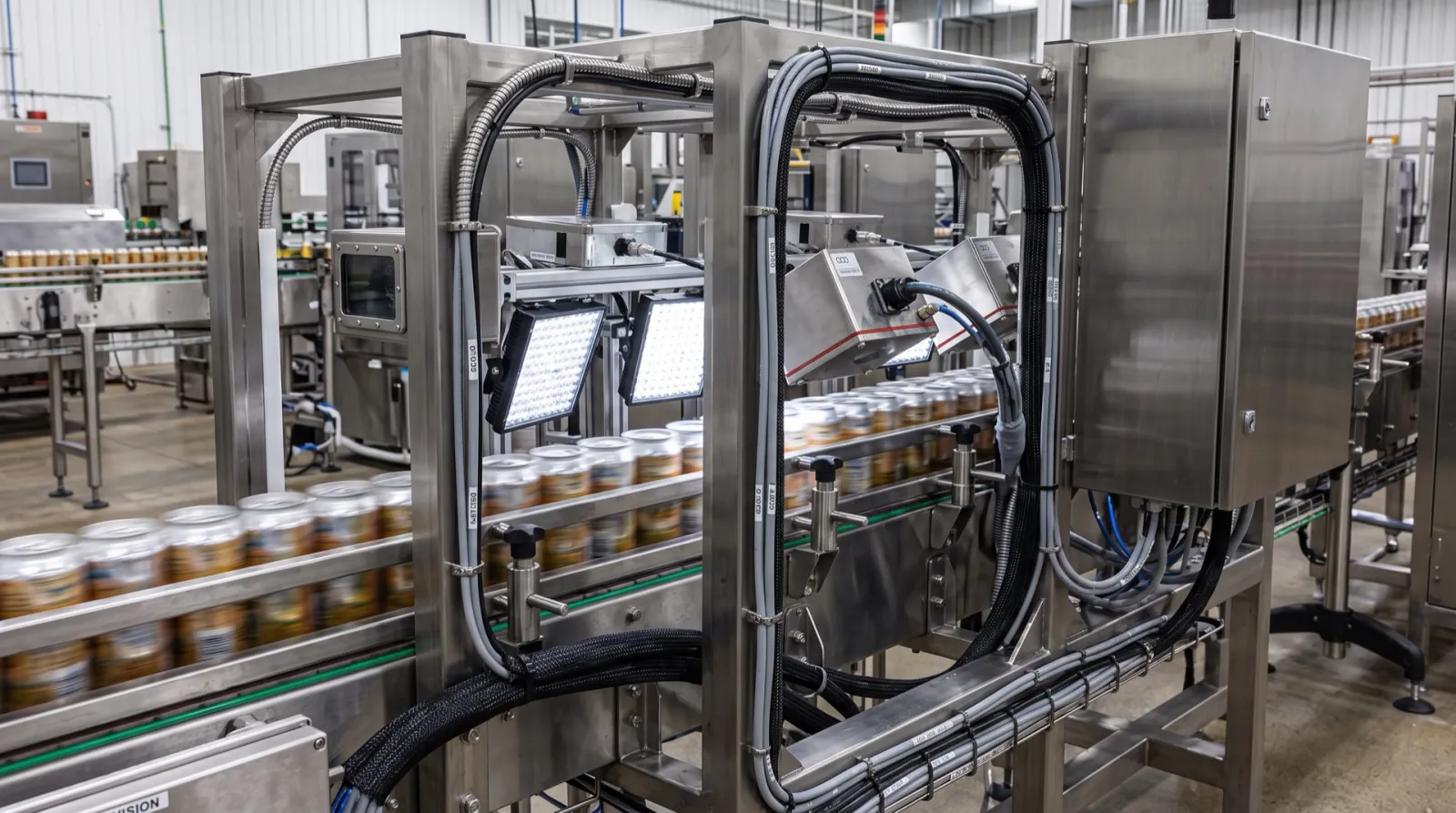
Vision inspection for medical device lines.

UDI labels, lot and expiry codes, pouch seals, missing parts and dimensions, checked on every unit and logged with its image.

Tell us about the system

Do JM Automated Solutions vision systems apply to medical device manufacturing?

Yes. JM Automated Solutions designs, programs, installs and commissions camera inspection and code reading stations for medical device lines: UDI label and lot or expiry code verification, print quality grading, packaging and seal inspection, presence and absence checks, and dimensional checks. Each result is logged per unit with its image. The stations are designed for use in 21 CFR Part 11 and Part 820 (QMSR) environments. Your own validation, IQ/OQ/PQ, stays with your quality team, and we supply the documents to support it. Vision inspection supports, and does not replace, the testing your quality system requires.

On the line

Which inspection tasks fit a medical device line?

UDI label and lot or expiry code verification

A UDI appears on the label in two forms, plain text and a machine-readable code such as a barcode. The device identifier is the fixed part; the production identifier carries the lot, serial number, expiry date or manufacture date (FDA, UDI Basics).

The station reads the barcode, reads the printed text with deep learning OCR, and checks that the two agree and match the job. Deep learning OCR outperforms rule-based methods on degraded or low-contrast codes and needs no per-code training. Round parts such as syringes, tubes and vials are read in any orientation, and inner and outer labels can be paired to the same unit.

Where this fits: Barcode station · Barcode tunnel

Print quality grading

Printed labels are graded on the label stock, and direct part marks are read and graded on the device material.

Where this fits: Barcode reading · Barcode tools

Packaging and seal inspection

The full seal is imaged for channels, wrinkles and a seal path that does not close, and the pouch is rejected before it is cartoned. The image stays with the lot, so a drifting sealer shows up on the line. Seal strength and package integrity tests stay with your quality system; the camera adds a check on every pouch between them.

Where this fits: Single-camera station

Presence and absence checks

Vision checks presence and orientation at the step where a component is added, and the next step can be interlocked if it is missing. The result is stored against the serial or the lot, so the device history shows the miss where it happened.

Where this fits: Single-camera station

Dimensional checks

Gauging uses calibrated optics and limits agreed with your quality team. Every reject keeps its image and measurement, so reviews are about the part, not the memory of it.

Where this fits: Three-camera station · Single-camera station

Regulated environments

How does data logging fit a regulated environment?

The station is designed for use in 21 CFR Part 11 and Part 820 (QMSR) environments. It supports your quality system; it does not stand in for it.

Data logging

A result for every unit

Each unit’s result is logged with its image, the reason and the time before the reject fires, and handed to the MES or quality system you already use.

Records

Designed for use in Part 11 environments

Part 11 covers electronic records and signatures kept under FDA rules (FDA guidance). Which station records fall under it is your quality team’s call; we set the station up and document it to match.

Who validates the vision system?

You do. Installation, operational and performance qualification (IQ/OQ/PQ) belong to your quality team and your procedures. JM Automated Solutions supplies the documents to support it: a functional specification, acceptance criteria, a site acceptance test, and IQ/OQ/PQ support documents. We plan the build around your cleanroom and change control, support the test runs, and your team approves and signs the result.

Regulations

Which FDA rules shape a device inspection station?

Always check the current rule text with your regulatory team. These summaries come from FDA’s own pages.

Part 820

The Quality Management System Regulation (QMSR)

FDA’s QMSR took effect on February 2, 2026. It amends the device CGMP requirements in 21 CFR Part 820 and incorporates ISO 13485:2016 by reference (FDA, QMSR). Inspection equipment on the line sits inside that quality system, so we document how each station is set up and checked.

UDI Rule

The Unique Device Identification System

The UDI Rule requires the labeler to put a UDI on device labels and packages, in plain text and in machine-readable form, and to present dates as YYYY-MM-DD (FDA, UDI Basics). A reading station checks that both forms are present, readable and in agreement.

Part 11

Electronic records and signatures

When a station’s results are kept as electronic records under FDA rules, Part 11 can apply (FDA guidance). Your quality team decides the scope; the station is set up for it.

Scope

What does JM Automated Solutions do, and what stays with you?

We do

What JM Automated Solutions does

Designs, programs, installs and commissions camera inspection and code reading stations; connects results to your PLC, MES or quality system; writes the functional specification, acceptance criteria and IQ/OQ/PQ support documents; and supports the test runs.

Stays with you

What stays with your team

Your validation and its approval, your quality system and procedures, regulatory decisions and submissions, and the testing your quality system requires, such as seal strength and package integrity tests. We do not approve equipment for regulatory use or make regulatory claims for your product.

Start here

Where do device teams usually start?

Service

Vision Data-Integrity Check

A fixed-fee gap assessment of the vision stations on one line, plus a review of user access, audit trails, recipe control and reject records. You get a written list of gaps and the fixes, in order.

See the service →

Next

Start with your line.

Tell us the device, the step that is escaping, and where the device history record is supposed to receive the result. If the pouch is the problem, say how your quality team tests seals today.

Tell us about the system