
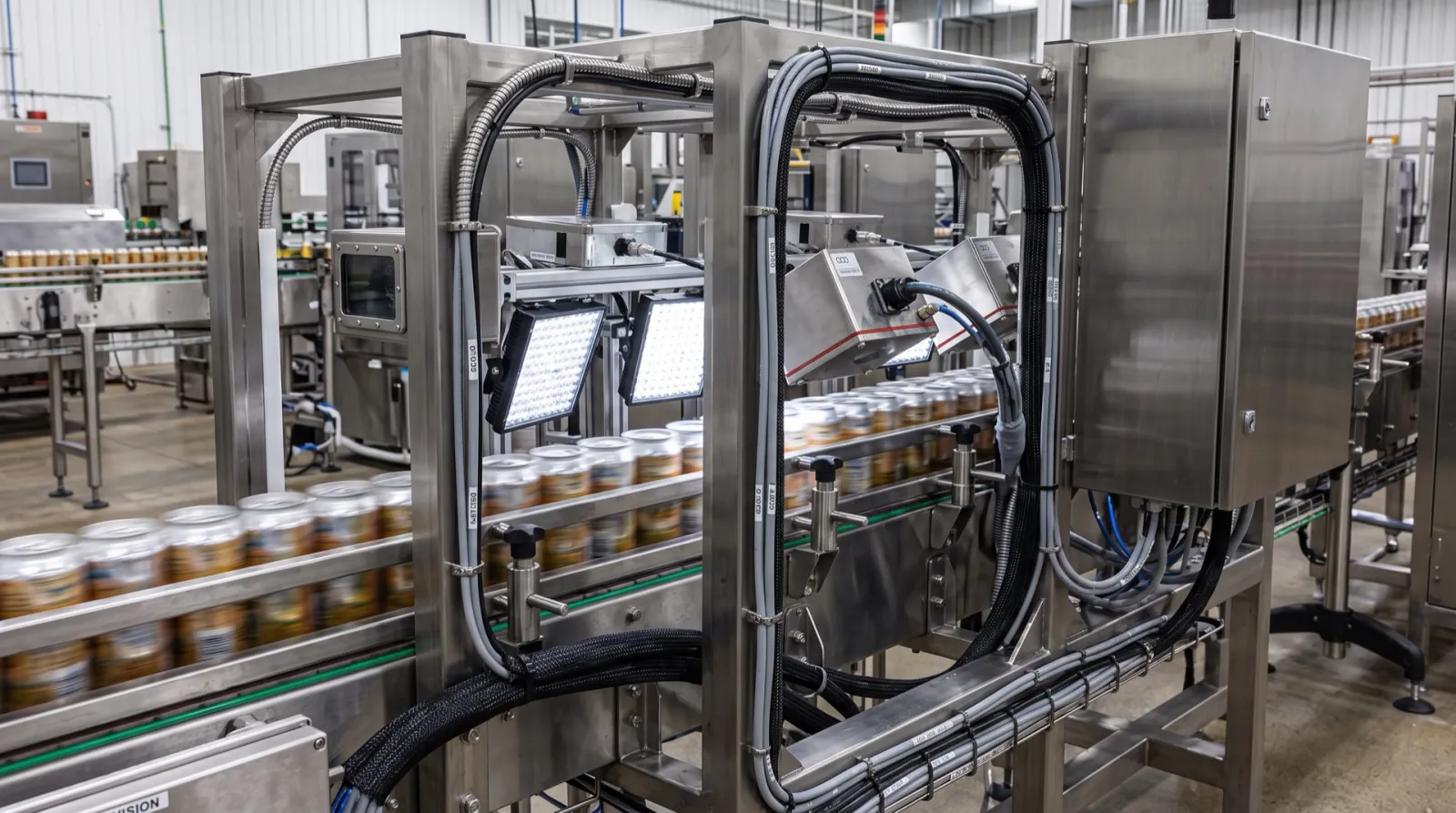
Wrong label or allergen panel after changeover
The last run's label or film is still on the line. See Food, Beverage and Packaging.
Get started
×Tell us about the line. A person reads it and replies.
Or talk it through first:
30-minute Google Meet call, Monday to Friday, 9 am to 5 pm Pacific.
Need a full study of the line first?
Every pack checked for the right label, a readable barcode, and the right date and lot for the order you are running.
Problems
The last run's label or film is still on the line. See Food, Beverage and Packaging.
Every code is read, graded inline, and matched to the order. See Packaging.
The printer smudges or skips the code, or prints last run's lot. See Packaging.
Each carton is checked before it leaves the cartoner. See Pharmaceutical.
Syringes, tubes, vials and round bottles arrive turned any way. See Medical devices and Pharmaceutical.
Wrong film, carton, can or label stock loaded at changeover is caught before the run starts. See Food.
Barcode inspection
Every pack, at line speed: is the code there, can it be read, and is it the right one?
1D barcodes
Linear codes on labels, cartons and cases are read and matched to the product running.
2D codes
2D codes are read, and GS1 fields such as lot, expiry and serial are split out and checked.
Print quality
The reader grades print quality on each read using ISO 15415 and 15416 methods, so a printer that is drifting shows up before its codes stop reading.
Text
OCR reads the printed date and lot. OCV checks the text against the value expected for the order.
Defects
No read
A missing label, a code outside the view, glare on film, or print too light to decode.
Wrong code
A readable code for another SKU, usually left over from the last run after a changeover.
Poor print
A worn printhead, ribbon or ink trouble, or a label stock the printer was not set up for.
Damage
Labels wrinkled when applied, scuffed in handling, or printed across a seam or a tight curve.
How it works
Reads and grades every code at line speed, and rejects or holds when a code fails.
Grades print quality off the line. Many plants use both: the verifier for the formal grade, the inline reader for every pack.
Reads the printed text.
Checks the printed text against the expected text. Date and lot checks use OCV because the expected value is known.
Setup
The pack, the code size and the line speed decide the setup. These are the choices the study makes.
Field of view
The camera has to see every place the code can land, with enough pixels across the smallest bar or cell to read it every time. The imaging calculator shows the trade-off.
Lighting
Diffuse or dome light for glossy film and curved packs, low-angle light for marks on metal or plastic, and polarizing filters against glare.
Hardware
A fixed-mount reader covers one face. For several faces or a wide view, GigE Vision cameras feed a vision controller.
Line
A photo eye triggers the read, the result goes to the PLC, and a failed pack is rejected when it reaches the reject.
Line speed
Motion
A short exposure and strobed light keep the bars sharp on a moving pack.
Orientation
Packs turned any way need omnidirectional reading or more than one reader. A barcode tunnel reads cases from several sides.
Decode time
Each read has to finish before the next pack arrives. Dense 2D codes and many codes per pack take longer, so the study tests them at your speed.
Spacing
Packs that touch can be seen as one. The gap and the trigger position decide which pack a result belongs to.
Limits
Upstream data
If the printer template or the product setup holds the wrong data, a code can read and match the wrong value. The check is only as good as the value it is given.
Formal grade
Inline grades show trends on every pack. A formal print grade comes from an offline verifier set up for it.
Hidden codes
A code under an overwrap, folded into a seam or facing away from every reader is a no read, not a pass.
FAQ
An inline reader reads and grades every code at line speed, and rejects or holds a pack when a code fails. An offline verifier grades print quality off the line for the formal grade. Many plants use both.
Yes. The expected code is set for the product running. A pack whose code reads but does not match is rejected or held, the same as a pack with no read.
Yes. 2D codes such as Data Matrix and QR are read along with 1D barcodes. GS1 codes are split into their fields, such as the product number, lot, expiry and serial, so each field can be checked.
A no read counts as a fail, never as a pass. The pack is rejected, or the line holds, depending on how the station is wired to your PLC.
Every JM station is handed over with the same documents, test and training. See what is handed over at site acceptance.