
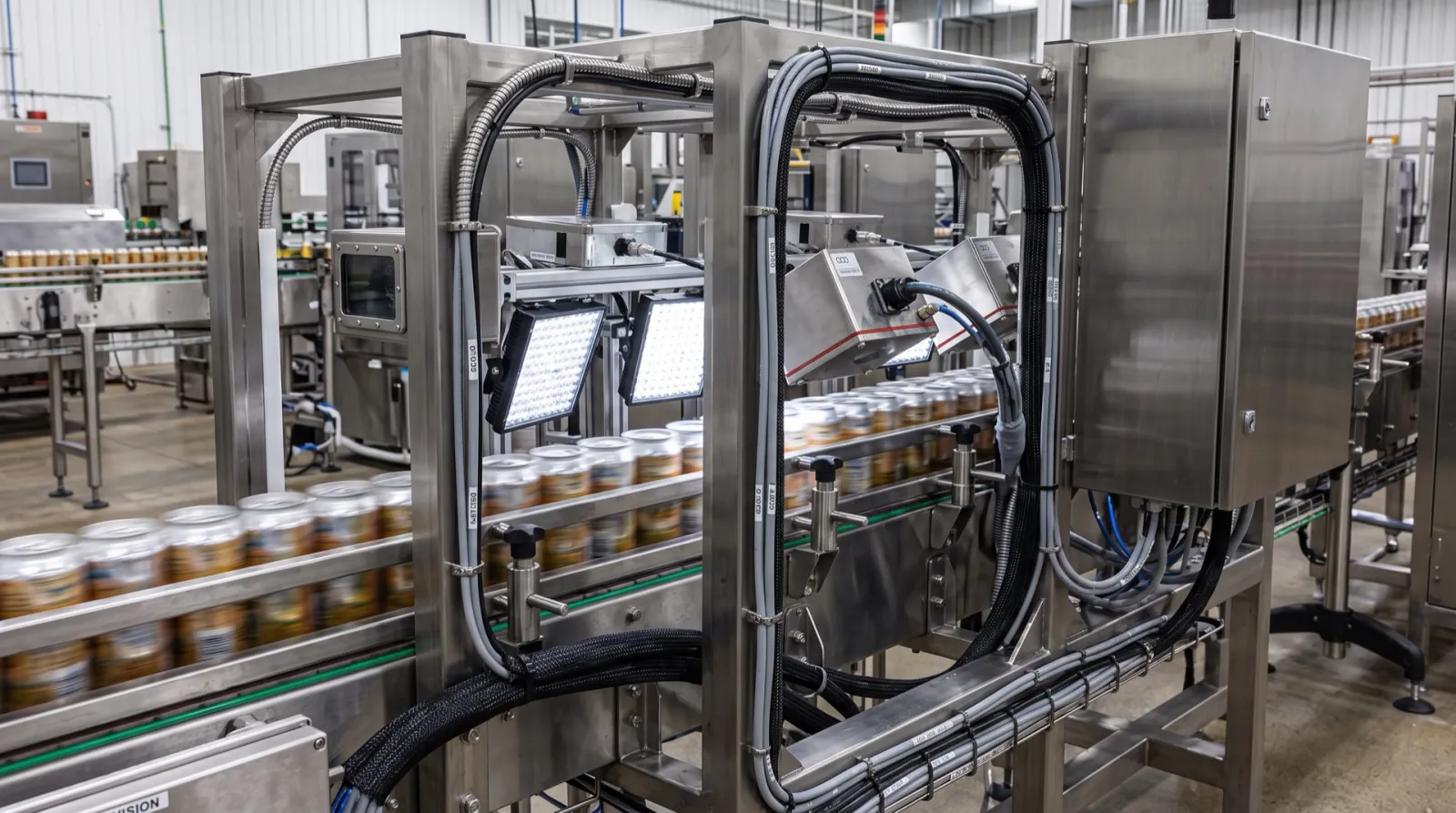
Empty containers are cracked or dirty
Inspect the empty container for the finish, the sidewall, and residue before the filler. Reject it before the filler, and tie that reject to the container lot.
Where this fits: Single-camera station
Get started
×Tell us about the line. A person reads it and replies.
Or talk it through first:
30-minute Google Meet call, Monday to Friday, 9 am to 5 pm Pacific.
Need a full study of the line first?
At beverage line speeds, a small inspection gap becomes thousands of units before anyone notices.
JM Automated Solutions builds camera inspection stations for beverage lines that check empty containers before the filler, fill level per valve, caps and tamper bands, and labels and codes after a changeover, at full line speed. A bad container is rejected without slowing the filler, and each reject is saved with its image.
On the line
Inspect the empty container for the finish, the sidewall, and residue before the filler. Reject it before the filler, and tie that reject to the container lot.
Where this fits: Single-camera station
Triggering and lighting are built for the closure. More than one angle covers the tamper band and the cap height. Reject timing is checked at full line speed, so a defect is off the line without slowing the filler.
Where this fits: Single-camera station · Three-camera station
Fill-level inspection is matched to the container and the liquid. Results are tracked per valve, so the drift points at the head that caused it. Divert and alarm limits live in the PLC.
Where this fits: Single-camera station
Label verification follows the active SKU: presence, position, and print in one station. The run is released only after the changeover check passes.
The barcode and date code on each bottle are read and graded, and the case label is read and matched to the product inside. A wrong code after a changeover holds the line.
Where this fits: Three-camera station · Barcode station · Barcode tunnel
We read the reject images and separate real defects from nuisance rejects, then re-tune the light, the thresholds, and the tools on the real product. The new settings are checked against a known-good set and a known-bad set before they stay.
Where this fits: Paid dry run on an installed station
See these on the problem finder · What the station records on each line
Inspection jobs
Solution
Fill level, seals, caps and tamper bands, and closure, checked on every container.
See vision inspection →System
Sees all the way around a bottle for caps, labels, and cosmetic defects.
See the station →Solution
The barcode and date code on each bottle, and the case label matched to the product inside.
See code reading →Service
A fixed-scope look at a station that is throwing good bottles away, with a written fix list.
See assessments →Guide
Clear glass, shiny caps, and wet containers need light designed for them. This guide shows how.
Read the guide →Tool
Estimate the focal length, the angle of view, and the size of one pixel on the container.
Open the calculator →There is no beverage-specific article yet. Beverage cans are closed with a double seam just like food cans, so the canning-line article applies to the seam check on a can line: How vision inspection catches double seam defects on a canning line. It was written for food canning, so the low-acid food rules it mentions apply to food, not to most beverages.
For bottles and closures, start with Lighting and optics for inspection.
Next
Tell us the container, where the fault shows up, and how fast the line runs. If a station is already installed and throwing good bottles away, say that first.
Other lines: Food · Packaging · Pharmaceutical · Medical devices · Supplements
Also: Upgrades for existing vision systems · Machine vision in San Diego County